Showing posts with label England. Show all posts

Sunday, 22 March 2009

Term papers, grammar, multiculturalism and a dog

Right now I feel panic and frustration lurking in every corner and corridor; there are so many things I should have done, and there simply is not enough time for it all. Tomorrow I will meet one of my groups for the last time before their term tests next week, and the main focus will be on the upcoming tests. This term test will be the last chance for the students to really show their skills when it comes to writing English papers, and I will therefore start this week's lesson by giving them time to browse through all the comments I have given them on their papers this year, and also time to dig into various grammar topics. I made this collection of task and activities on grammar last week, hoping that everyone would find some exercises that could help them improving their grammar. We started working on these exercises last week, and I hope that some saw that this could actually help them; many asked if I could explain a bit more, and some said that they finally understood why I corrected them when they wrote "everybody are doing their best." Most of the exercises in this lesson plan are taken either from the Tracks/Passage pages or from Exploring English. I find it useful that these pages explain the grammatical topics in Norwegian, and that the English terminology is listed at the same pages.

This week I have also planned to continue working on multicultural Britain. The film last week was a success, and this week it is time to look at some facts and figures concerning immigration to the UK and how multiculturalism affects the British society. As I have said before, I have had some problems finding up to date-information on the topic, but hopefully we will manage by the resources available. My idea is that the students are to work in groups of four preparing a presentation on multiculturalism, hoping that a group activity will keep most of them busy and forcing them to read some of the texts I have picked out for them.

Last stop on this week's agenda is The Curious Incident of the Dog in the Night-Time. Most of the students have managed to get hold of a copy of the novel, and it is time to start working on it. Knowing that reading is not the favourite occupation of many of the students, I believe it is necessary to give them time for reading at school, at least in the beginning. I suppose most of the students will find that reading the novel is not all that hard, and therefore I want them to do a close reading of at least parts of the book. My colleague Ann gave me the idea of letting the students pick out central paragraphs in the novel and then to explain their choice. I have therefore planned this rubric for them, and I will introduce it before they start reading so that they know what to put focus on. My colleagues Anne and Kjetil also suggested that we put focus on the characters and Anne has prepared this rubric in which the students have to fill in information and reflections on the various characters we meet in the novel.

My guess is that I have more than enough activities to fill the days this week, too, and that I have probably tried to squeeze too much into one day. My main goal, however, is to present activities that will engage my students in various way, and that they feel that they have actually done a good day's work by the end of class.


Photo: www.flickr.com/photos/62518311@N00/86907303

Monday, 16 March 2009

East is East and multicultural Britain

Walking the streets of almost any British city you meet people from all corners of the world, and stating what is typically "British" gets harder and harder. Ever since World War II a great number of people from the former British colonies have come to England in pursuit of a better life. All these people have, of course, given their contributions to the British society and influenced post-war Britain in various ways. This week we wanted to put focus on multiculturalism in Britain in class, and as an introduction to the topic we showed the movie East is east. The film is hillarious, but there is also a serious tone throughout, displaying the problems second generation immigrants face in Britain early in the 1970s. Growing up with a strict Muslim father from Pakistan and a more liberal British mother, the seven children in the Khan-family find themselves torn between the wishes of their father and their ever-growing identity as British.

In an interview the author of East is east, Ayub Khan-Din, tells that there are many parallels between the story of East is east and his own life: The parents are drawn directly from my own family. The youngest boy, Sajid, is me as a child. All the arguments in the film, all the theories behind the father's way of thinking, are my own arguments and theories which I developed from writing the first draft of the stageplay to the last draft of the screenplay. The different issues, the different aspects of different relationships - they're all very similar to my own background. Hence we can probably see the film as a realistic portrait of what life was like for young, ethnic Brits at the time. But what is the situation like today? Is the gap between the generations as wide as it used to be? Do second generation immigrants face other problems in Britain today than they did 40 years ago? I have tried to find some resources that could highlight some of these questions, but I have not found many yet. "The truth of multicultural Britain", published in The Guardian in 2001, is quite informative, however, telling how there is not "a single 'ethnic minority experience' of life in Britain", but a complex pattern of opportunity and disadvantage with as many differences within and between different ethnic groups as can be found by comparing the 'ethnic minorities' to the general population. An other page I like is the UK in the USA-page where we can read about the history of immigration, and also about how Britain is a result of its post-war immigration history. "Everything in modern Britain - from music and fashion to food and language - has been shaped by different ethnic communities, cultures and social groups," the article says, and in this way we may all be seen as influenced by this multiculturalism. One final page worth mentioning is the BBC page on the history of immigration from the 250 AD to the present.


Photos from allmoviephoto.com

Monday, 2 February 2009

Billy Elliot

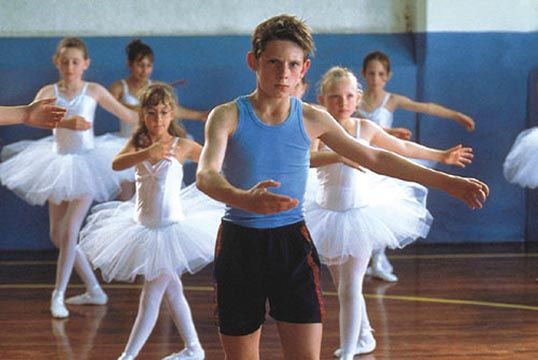
Teachers love it, many students simply hate it: the film "Billy Elliot". I have shown this film to my students several times, and time and time again I have heard that this is a film for sissies. Neverthelsess, I believe this film can illustrate many elements in British society, if the students are just willing to look beyond the plain story of a boy who finds more pleasure in ballet classes than in boxing. In this film we can see the fragile relationship between father and son, an eleven year old boy missing his mother, and a community which is totally paralysed by the longest lasting miners' strike in British history. When working with this film, it also makes sense to discuss regional differences between the northern and southern parts of England, social classes, what kind of expectations out society has to boys and girls, and to which extent it is important to pursue your own dreams in life. It is a fact, though, that this film is almost ten years old, and that most of our students believe 1984 to be in the Stone Age... Anyway, under I have listed some resources on the film, and despite protests from the students, I believe I have not shown Billy Elliot at school for the last time in my career.

Photo: Arts journal

Thursday, 15 January 2009

Buddha, Bowie and Suburbia


In September 2007 we were going to put focus on multiculturalism in England. As our point of departure we chose an extract from Hanif Kureishi's novel The Buddha of Suburbia. The text deals with clashes between different cultures in England, and also clashes between generations. As an appetiser to the text, we found a video with David Bowie's song from the TV series which also includes some glimpses of the protagonist of The Buddha, Karim. We also watched an interview with Hanif Kureshi that was given when the TV series was to be broadcasted in Britain. Unfortunately, I cannot find this interview on YouTube at the moment, this is of course a weakness of some of the resources you can find on the internet, but there are several other interviews and videos out there which can be used when introducing this text/topic. The students seemed to like the two videos because they gave them something visual that could be linked to the text, and I believe some were a bit curious too having seen Karim's father upside-down, in the nude, practising yoga...

Anyway, some of the students found the extract we had chosen for them to be quite difficult, and I believe an easier text could have presented the conflicts of this novel just as well . We therefore decided not to put this text on our reading list this year. Maybe the text would have worked better if the students were older, and also if we had read the whole novel, not just a few pages. Talking about The Buddha of Suburbia we also have to keep in mind that this novel portrays multicultural London in the 1970, and that a lot has happened since then. My point is, however, that using videos from for instance YouTube can serve as an introduction to various topics we all deal with when teaching a foreign language like English. I am 100% sure that the introduction to the novel that Hanif Kureishi gave in the interview mentioned above is a whole lot better than any introduction I could have given.